Thursday, July 14, 2011

Our Sweet "Bump" RV - 1971 Ford Scamper

July 14, 2011

I subscribe to the Amherst Buy and Sell Facebook Group, and I see things for sale posted in my news feed all the time but never pay much attention to it.  On July 13, 2011, I saw a beautiful old RV listed for sale and after I read the ad, I hollered excitedly to Jeff and told him to go on the Amherst Buy and Sell site right now and look at the RV for sale.

The funny thing is, other than stating to each other that we were getting tired of tenting and our tenting days were soon over, we had never ever discussed buying an RV.  However on this day it seemed that we were reading each other's minds as we never even discussed it...Jeff got on the phone right away and called the number in the ad and made plans to see it the next day.

On our way there, I told Jeff I was half expecting it to smell like mold and mildew being that it was a 1971 model and probably had leaks.  However we were pleasantly surprised - it didn't smell at all.  We just loved the camper, took it for a test drive and fell in love with it even more.

It is a 1971 Scamper, built on a Ford F350 chassis cab truck with a walk-through (cutaway) from the camper to the cab of the truck.  These campers were made by Pre-Built Mfg. in Lethbridge, Alberta.  The truck had 115,000 miles on it.


Below is a video of the previous owners showing us around the Scamper, and us taking it for a test drive.


So after the test drive, Jeff and I both loved it and wanted it.  Even though the interior of the camper really needed some freshening up, I was already having visions on how I was going to add my personal touch to it and make it "ours".  So after some negotiating on the price, it was a done deal and we drove her home!

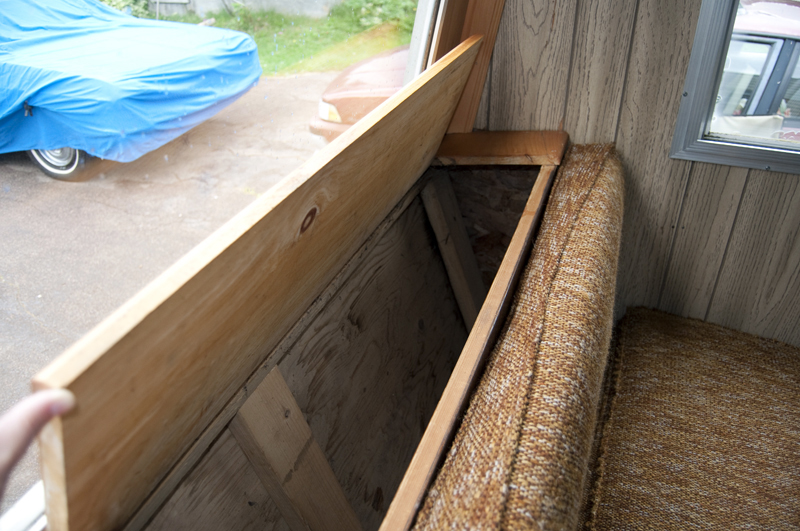
After we got it home, I took some pics of the interior.  


There was a double air mattress in the cab-over bunk.  I found it extremely uncomfortable and I would never get any sleep when I slept on it.  We remedied that last summer (2012).  I had two single self-inflatable air mattresses - very thin but good insulation factor.  I put those on the floor of the bunk, side by side, as a base.  Then I bought two 1.5" memory foam toppers at Wal-Mart and put those on top of the air mattresses.  That made the biggest difference in the world!  I sleep like a log now and I think that bunk is even more comfortable than our own bed.


The kitchen is fully equipped, with propane appliances (fridge, stove and oven) and they all work.  It has a Hydroflame radiant heat furnace, which is vented to the outside to both draw in fresh air for combustion and also to vent the exhaust gasses outside.  I started the furnace up and it works great.  We have a CO detector and I ran the furnace for 3 hours with the detector inside, and checked it every half hour to make sure it was working right and that the detector didn't go off.  The furnace worked perfectly, and the CO detector never went off.  To be extra safe before we ever use this heater I would like to get a propane detector too.  We like to boondock camp (not in campgrounds) so this type of furnace is perfect for this type of camping.  The furnace uses no electricity whatsoever, so it will not run down the house battery.


This is a heater for using when the truck is running.  There are hoses that run from the engine to this little radiator.  It works too.


I had lots of ideas on what I wanted to do with the interior.  Below is a list of everything we did:

  • We primed and painted all the wall paneling, the fridge, the drawer fronts and cabinet doors on the right side.
  • My mom helped me mactac the kitchen cupboard panels with a dark brown checkerboard-type mactac.
  • I painted the bench by the door and the outer panels of the dinette benches dark brown.
  • I made new curtains for all the windows.  Jeff and I went to the fabric store and picked out the material together.  We chose a dark brown checkerboard type of material, and I lined the backs of the curtains with white thermal backing.  This helps keep the heat out in the summer, and keeps the heat in when it's cold outside.
  • I also made new covers for the all the bench cushions.  Jeff helped me pick out that fabric too.  We found a nice fabric on sale that had dark brown stripes to match the curtains and beige stripes to match the walls, and it also has pale yellowish-green stripes that match the table and counter-top.  It complemented the decor perfectly!
  • The final touches for the interior were some fake plants (velcroed to the shelf), a rug outside the bathroom door, and new bedding that matched the rest of the decor.

Below are the "after" pics once all our decorating was done.  The one thing we wanted to do but never got around to it yet is replace the vinyl floor tiles with new ones that match the new decor.  We might work on that this summer.


One problem we encountered after our second trip in the Scamper was the dump valve.  It broke, but luckily it broke AFTER the black tank had been dumped and rinsed.  I am on a vintage RV forum and I posted on there asking if anyone knew where I could get a dump valve like this.  Everyone who responded said they were obsolete and I would never find one.  I then got in touch with a gentlemen who used to build Scampers, and I sent him some pics of the old dump valve and asked him how I go about replacing it.  He wrote me back and said "my God, I haven't seen one of those in about 30 years."  He was very surprised that it still functioned up until our last trip.  So he told me which dump valve I should buy, and gave me detailed instructions on how to install it.  The dump valve I was supposed to get had an elbow at the end which angled downwards.  However the RV dealer ordered in the wrong one (a straight one, with no elbow) and I said the hell with it I'm not waiting two weeks for another one so we put this one on anyway.  The downside is it's a bit more difficult to hook on the sewer hose.

This is the old dump valve:


And this is the new one.  We've used it many times and it works great.


Below are the specs on the chassis of the truck.  It's a Ford F350 dually, with a 390 FE engine.  It has an Autolite 2100 carb (which currently needs replacing).  It has a Dana 70 rear-end.


I was doing some searching on the internet about Scampers, and I found this brochure.  This brochure is for a 1970 model and ours is a '71, but they're pretty much identical.  The interior layout is a bit different.  However it was great finding this brochure as it gave all the specs of the camper such as it's tank capacities, length, height, construction, etc.


Below is the truck's owner's manual compared to our 2011 Hyundai Elantra's.  Quite a difference!


The spare tire under the camper was in really bad shape - we'd never be able to use it so we bought a good used one last year.


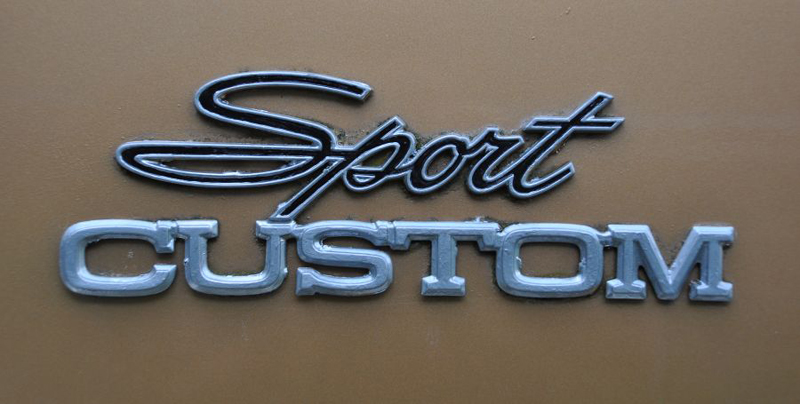
The truck was painted about ten years ago, and the painter sprayed over the emblems.  I've read that the emblems can be very brittle and difficult to get off without breaking them on vehicles this old, so that is probably why the decision was made to paint over them.  I bought some chrome-coloured paint and black paint, and used one of my artist's brushes to hand paint the emblems to make them look better than they were.


This is Jeff changing the oil.  Look at the door of the truck...these old Ford trucks are known as "bumpsides" or "bumps" because of the raised ridge on the sides of the truck.  Only the 1967-1972 era Ford trucks have these "bumps."


Our neighbour just happened to have a 1971 license plate in his shed and he gave it to us.  I love having the vintage plate on the truck and think it really suits it.


Jeff really wanted to get a set of half-moon headlight covers for the truck, so we ordered these off Ebay last summer.  I think they really suit the truck!


I love old stuff, and I had this little washboard in the basement.  I thought it would be a great thing to keep in the camper. It is velcroed to the wall (in a house on wheels velcro is your friend!).  I figured if we ever ran out of underwear while on a trip at least we've have a way to wash them. lol


Another thing we wanted to do to the truck was spruce up the engine a bit.  I degreased the engine with engine cleaner, then we wanted to paint the air cleaner and valve covers.  Here is what the engine looked like before:


First we cleaned up the air cleaner with a wire wheel and got all the rust and old paint off it.  Then Jeff sprayed it with Dark Ford Blue engine enamel.


I ordered a new air cleaner decal for it, and here is the finished air cleaner back on the engine.  We didn't do the valve covers this year as that's a pretty big job we weren't ready to tackle yet.


People kept asking us if we had named the camper yet, and we hadn't...we figured let's just use it and maybe one day a name will come to us.  Well the name did come to us on the Margaree River last summer.  We were salmon fishing and I said to Jeff we should name the camper "Shady Lady".  A Shady Lady is a type of salmon fly.  We got our friend to make us up some "Shady Lady" decals for her and here they are installed:


And lastly, below are some pics of her in action:


Every year the son of the camper's prior owner lets us store it in the garage where it has slept every winter for the past 12 years.


Here is a short video of her coming out of winter hibernation last year.  Jeff pumped the gas pedal a bunch of times and after cranking it for about ten seconds she started right up.


In spring of 2015 we replaced some sections of floorboard and put new sticky tiles down:


Below are links to all of my posts about the Scamper:

Scamper Floor Repair and Floor Covering Replacement

1971 Scamper Upgrades - Propane Regulator and Norcold N300.3 Fridge Install


Saturday, September 27, 2008

Jeep Stuck in Quicksand

It is September 27, 2008, and Jeff came up from the valley.  We wanted to pre-run a trail as the Jeep Club was coming up the next day for a run here and we wanted to make sure there were no trees down or anything.  One of the cardinal rules of Jeeping is to never go alone.  And just because Jeff and I were together in one Jeep, that still constitutes Jeeping alone (without another vehicle along).  However the last time I ran this trail was in the summer, and everything was quite dried out so I told him there was nothing we would encounter back here that could get us into trouble.  It's a really beautiful trail, and it was a beautiful warm fall day.

However, there had been some significant rain recently.  There was mud, and quicksand.  I'm sure you can tell where this is going....and there will be a moral to this story at the end!

It did start out as a dry trail...


About 20 mins into the trail we encountered some water, but it was hard-bottomed so it was no problem even for my stock Jeep.


There were also some washouts to give me a little bit of a challenge.


Then, disaster strikes.  I entered the next puddle, which was NOT hard bottomed and I didn't get very far before I lost traction.  I tried backing up but then realized I was starting to sink.  I was stuck.  Jeff and I got out and assessed the situation. I always carry boards in my Jeep to use as a base for the jack, so I thought let's try jacking it up then maybe we can put some brush under the wheels for traction.  So we jacked it up, but it was a losing battle.  As I jacked, bubbles were gurgling up from the mud, and our feet were sinking, as was the jack and the Jeep.  The mud was actually fine sand.  The bubbles kept bubbling until the Jeep was actually sitting on its belly.


So....on to Plan B.

Unfortunately I did not have a winch, but did have a recovery strap.  We tried tying one end of the strap to a tree, and the other end to the back wheel of the Jeep.  Then we put it in gear and gave it a bit of gas to spin the rear wheel slowly, which tightened up the strap as it twisted.  The hope was that with the continual twisting of the strap, it would get shorter and shorter and actually pull the Jeep sideways out of its hole.  It actually did start to work, and the Jeep started to move sideways, but then the strap broke with an incredible bang that sounded like a gunshot!  Oh well, so much for that idea.  We didn't have cell phone service deep in the woods, so we had to walk a couple of kilometers before we got service.  Once we got service, we called a friend to come and get us.  It was about another 2kms of walking before we got to the logging road where our friend was picking us up.

The walk of shame. lol


It was getting dark out and we were starting to get nervous about the local wildlife, of which there was lots of evidence of them being on our trail very recently - coyote and bear tracks, and pretty fresh too!  Thank God we made it out without running into any.


So, the moral of the story is:  Never wheel alone.

However, everyone does at some point and sometimes we just enjoy going to the woods by ourselves.  So if you would rather go alone, make sure you have a winch or at least a come-along, and it would also be good if you had a friend you could call who could actually come in and rescue you.

The next day a bunch of people from the North Nova Chapter of the Nova Scotia Jeep Club came up for a run and they extricated my Jeep for me.  As we approached my Jeep we were so happy to see it still intact, as we were worried that a bear might have tore the soft top open and ransacked the interior looking for the cereal bars that I had forgotten in the Jeep.

And this is just the beginning of many more Jeeping adventures to come with Jeff and I. :)

Saturday, October 28, 2006

Tundra Buggy Trip to See Polar Bears, Churchill, Manitoba (October 2006)

In 2006 I spent some time in Manitoba with my ex-boyfriend who was working there doing bird surveys. One of the time periods we were going to be there was in late fall, which was perfect timing for the polar bear migration in Churchill.  In October and November, the polar bears leave their summer habitat and gather here waiting for the pack ice to form on the Hudson Bay so they can go out on the ice and hunt for Ringed Seals, their favorite meal.   We decided to book a one-day package tour with Heartland International Travel & Tours. The tour we booked was on October 28, 2006, and included the flight from Winnipeg to Churchill, the bus to the Tundra Buggy launch site, all day on the Tundra Buggy, and supper in a restaurant after the tour. 

Our day began around 7:00 am, when we boarded the small plane for Churchill. We took off while it was still dark, and got to see a beautiful sunrise while in the air.  This was the smallest plane I've ever been on.


As we flew north you could see the landscape changing into a vast wilderness area that had a lot of partially frozen lakes and light snow cover.  I was video-taping this scenery, and unfortunately didn't get any still photos other than this one but we were above some clouds at this point. 


After about a 2 1/2 hour flight, we landed in Churchill. On the descent, we saw 7 moose and 3 polar bears - so the trip was off to a good start! 


The weather was overcast with light flurries.  After getting off the plane, we noticed a camera crew and soon found out that Al Roker from NBC's Today Show was just getting off of another plane and that he would be on a Tundra Buggy today as well, but he was with a different tour company so he wouldn't be on our buggy. After the trip was over we heard about the show Al Roker did on the Churchill Polar Bears.  Here is the YouTube link for the show:


We next boarded a bus which took us out to the Tundra Buggy Launch site.  This was our buggy:


We boarded the buggy and sat in the very back. We wanted to have close access to the back door where you could go out on a viewing platform to photograph the bears.  There was also a little fireplace in the back.

The Tundra Buggy headed out on the trail and the first interesting sighting we came across was a flock of Willow Ptarmigan, which was a lifer bird for me.  Al Roker called them "Artic Chickens". lol


The next cool critter we saw was an Artic Fox. We actually ended up seeing two Arctic Foxes on this trip, which was a real bonus. 


Our driver, Mark, would turn the buggy's engine off each time we stopped which the photographers really appreciated. The next sighting was a Snowy Owl, and we also saw many flocks of Snow Buntings all throughout the day. This is one of them:


The buggy felt like it had giant marshmallows for tires.  It bobbed and bounced along on its big tires.  The large wide tires prevent damage to the delicate tundra.  


Then we finally started seeing polar bears. The first couple of bears we saw were a fair distance away so we didn't spend much time observing those ones.  The driver knew there were much better viewing opportunities up ahead. When we got near one of the Tundra Buggy lodges we started to see a lot of bears, and at fairly close range. I was very excited when we saw our first bear, even though it was at quite a distance. 


And another one:


Looking down at the ground I saw a huge paw print:


Finally when I got to see the bears up close, I was just beside myself with excitement and couldn't believe I was actually here with these beautiful, magnificent creatures. I didn't know whether to video or shoot stills. My camera ended up winning, as I gave still photos higher priority than video. Only after I was satisfied with the shots would I switch to the camcorder. I think a large zoom lens was the best tool for this trip (I had a Sigma 170-500mm on my Nikon D70) because it allowed me to adjust my focal length as the bears moved towards or away from me. Many of the photographs I took were frame-filling images, many at focal lengths less than 500mm.  

A lot of the bears were just lying around, waiting for the ice to freeze.


It was quite exciting whenever one stood up or walked around.  They looked so slow, lazy and gentle...but I know they would eat you in a heartbeat if given the chance.  They are hungry - and they've been known to cannibalize their own cubs.


At one point while we were viewing a bear the driver pulled over to the side of the trail to park and turned off the engine. The buggy was on a slight tilt to the left. Once it stopped, everyone rushed over to the left side windows to look at the bear, and the buggy's suspension compressed and tipped it sharply to the left and it felt as though it was going to flip right over! People immediately ran back to the right when they felt it tip so it balanced itself out again. Gave me a bit of a scare there for a minute though.  Tipping over in Polar Bear country would not be a good thing!

So after that heart-racing moment, onward we go.


In the top right of the picture above you can see the Tundra Lodge.  This is another kind of tour you can experience (if you have lots of money).  It is a mobile lodge.  You are are driven out to the lodge on a Tundra Buggy and you can spend days at the lodge, sleeping out on the Tundra with the bears.  Below are more pics of the lodge:


Later in the afternoon the sun peeked out from the clouds and created the most amazing light; and the bears I was photographing were on the right side of the light - what luck. 


There is a sad reality about these polar bears. Global warming is causing the sea ice to break up earlier every year, which gives the polar bears less time on the ice to feed (their main source of food being ringed seals), and more time on land in "walking hibernation". The Hudson Bay polar bears are unique in that they become landlocked for a few months of the year. During that time their weight drops significantly. If global warming continues and the ice breaks up earlier and earlier every year, one day the polar bears may starve to death. Today the effects of the early ice break-up due to global warming are causing declining weight in both male and female bears, and female bears are having fewer cubs, and the bears are actually cannibalizing their own cubs. Since the sea ice season is the shortest in Hudson Bay of all the regions of the Arctic Ocean, these bears' survival is threatened as they are likely to be among the first to be affected by sea ice decline. 

Unfortunately all good things must come to an end, and it was time to head back. However on the way back we were all treated to great looks at an Arctic Hare, who sat there cleaning his foot while we watched and took pictures. 


When we got back to town, we were taken to a restaurant for supper.  I had Arctic Char and it was delicious. After supper we were given a half hour to shop for souvenirs in a gift shop close by, and the store was crammed like sardines with all the people from the tour.  A half hour isn't much time, and there was so much to look at.  I really wish we had more time. 

It was dark when we boarded the plane for our return flight to Winnipeg. To top off a incredible day, we had a fantastic display of northern lights from the plane. What a great way to end the day! 

I met some really wonderful people on this tour, and hope to do this trip again someday. Many thanks to Don Finkbeiner of Heartland Travel, the trip organizer, for offering a one-day tour which made this long time dream of mine an affordable reality. The book provided to all participants at the end of the tour was a real nice bonus that we weren't expecting.

Thursday, May 27, 2004

Keji Trip from Hell

This story is a narrative of our canoe camping trip in Kejimkujik National Park on the Victoria Day long weekend of 2004.

On May 22nd, Simon and I began our journey to Site 31 on Peskowesk Lake, in the southern area of Kejimkujik National Park. Travelling down the main road of the park, we had our first wildlife sighting of the trip when we spotted a white-tailed deer in the woods beside the road.


We put the canoe in at the eel weir (on the Mersey River) and took portages A, B, C, and F.

The day was overcast and became sunny in the afternoon. With the onset of warmer weather the black flies were out in full force. They weren’t too bothersome as we had bug netting to wear over our heads, which protected us quite well.


We stopped at Site 26 and visited a coworker and his family before continuing on to Portage F. In retrospect, I think this was probably the highlight of our whole trip. After our visit we continued across Mountain Lake to Portage F. Once we arrived at the end of the portage we began setting up camp at Site 31, at which point it started to rain. Despite the rain, I’m still smiling.

The next morning was overcast with showers, but there was no wind and Peskowesk Lake was very calm which made for an easy paddle to Portage K at the other end of the lake. As we started paddling away from Site 31, a painted turtle poked his head above the water as if to bid us adieu and then disappeared.

During our paddle across to Portage K, we had to frequently sponge the bottom of the canoe to keep it from filling with rainwater. At the end of this portage was Beaverskin Lake, which is a beautiful little lake with crystal clear water. Most of the lakes at Keji are tea-coloured from tanins in the bogs. We filled up our water jug in the middle of this lake and then sat quietly for five or ten minutes and watched two pairs of loons diving for fish.


At the other side of Beaverskin Lake we took Portage M to Peskawa Lake, and Site 40, our next site, was on the opposite side.

As we approached the site, the sky started to clear. Once close to the shore, we found that the beach had virtually disappeared due to the high water levels. Docking the canoe without getting wet feet was tricky, but we managed. Sand bars prevented us from getting close to shore but by docking at the far end of the beach we were able to exit with dry feet and then line the canoe closer to the campsite to remove the gear.


We thought we had really lucked out when the skies cleared and the sun came out. Simon set up the tent while I strung the tarp and bug netting over the picnic table.


The bug net canopy was quite effective but a few still managed to sneak in.

This is a beautiful site, and I’d love to come back during the summer (so I thought) when the water levels are lower and the beach is exposed. There is a nice little brook that flows from the woods, through the sandy beach and into the lake. Unfortunately this is a breeding ground for mosquitoes and black flies, which were plentiful at this site.


It was a beautiful evening at Site 40. It had almost totally cleared and the lake was like glass. I went to bed still smiling…very pleased that we had found this beautiful site.


We awoke the next morning to rain. We got up and had some breakfast, and then decided to retire to the tent and sit tight for a while hoping the rain would subside. By noon however, the rain had intensified and we decided we had better pack up and head for our next site, which was Site 32 on Peskowesk Lake. The wind was up slightly but it was still pretty easy going on Peskawa Lake.

When we reached Site 38 at the end of Peskawa Lake, the wind had picked up quite a bit and we decided to stay put at this site to see if the wind would die down. It was still raining so we set up the tarp over the picnic table for a shelter while we waited. We were there for only a short time when the wind seemed to disappear completely, so we packed up and started paddling across the little lake between Peskawa and Peskowesk lakes. It was raining but I made the comment to Simon, “at least the wind is gone.” I would soon swallow those words. We were now at the beginning of Portage N.

This is a tough portage. It is about 1 kilometre long, and is a winding, narrow trail full of slippery roots, rocks and holes. We carried the canoe and all the gear to the other end, which was the eastern tip of Peskowesk Lake. We were disappointed to arrive here and find the wind on the lake blowing directly at us and too strong to attempt to paddle. We decided to sit it out and hope that by suppertime it would ease up. We turned the canoe on its side and put the keel to the wind to create a wind block.


The skies looked very threatening, so we strung a tarp from the canoe to two nearby trees to create a makeshift shelter. Within minutes of completing this it began to rain.

At this point, I am no longer smiling. This is not fun anymore. I’m starting to regret leaving Site 38 behind as now we are between two lakes without a campsite, and the weather is looking very threatening. I really struggled carrying the canoe and gear along this portage, as it was such rough terrain. Simon did a longer haul than I with the canoe and wasn’t having as much difficulty as I was, but my shoulders and legs were really fatigued from the six portages we did over the past couple of days. Regardless, we decided that going back to Site 38 was not an option. Just the thought of backtracking a kilometer with the canoe and all the gear exhausted us. We decided we would wait until evening, and if the weather had not let up we would pitch the tent right there on the path and spend the night. At about 5:00 pm we shared a package of broccoli and cheese rice for supper, and that would be the last food we put in our mouths for the next 24 hours.


At 6:00 pm, the wind had intensified and we decided to pitch the tent and spend the night. Since we were not at a campsite, we had no firewood, no toilet and no tent pad. We pitched the tent on roots and rocks, and are thankful that we have a small tent as it just fit in between the trees and rocks. The following picture is Simon standing on the spot where we pitched the tent. This will be the last picture I take from this trip.


Before retiring to the tent there was one last task we had to do…suspend our food, pots and garbage from a tree so a bear wouldn’t help himself to them. We have never had to do this before as we always stored our food in the campsite outhouses. I tied a stone to end of a piece of rope and threw it over the highest branch I could reach. Then Simon tied the rope to the bags and hoisted them up until they were about 10 feet off the ground, and tied the rope to the tree trunk. I could hear the wind rustling the bags through the night and my heart would start pounding in my chest thinking that a bear was trying to get at them.

It was a relief to get inside the tent and curl up inside our warm sleeping bags. I checked the temperature outside before we came into the tent and it was about 10 degrees. After we were inside the tent for about an hour I took a temperature reading and it was about 18 degrees so we were quite comfortable. I drifted off and had a nap while Simon read a book.

A short time later I awoke to fierce winds blasting our tent. The sound of the wind was frightening – it was a loud roar like I’ve never heard before. Then the downpour came. The rain pummeled our tent so hard that we could barely hear what the other was saying. Then as if that was not enough, it began to thunder and lightening. The thunder was so loud it shook the ground beneath us. The lightening lit up the inside of our tent like it was daylight – I’m sure the lightening strikes were right on top of us. I was absolutely terrified that a tree was going to fall down on top of us or that we’d be struck by lightening. I was crying with fear while Simon snored away!

I did not sleep much at all that night. I think I may have fallen asleep around 4:00 a.m. for a couple of hours. We had planned to get up at 6:00 a.m., thinking the winds would have subsided by then and we’d be able to paddle out. Imagine how we felt when we peeked outside the tent to see whitecaps on Peskowesk. We went back inside for a couple of more hours, pondering what we should do. We finally decided to take the canoe and all the gear back to Site 38 (across that horrible portage trail), leave everything there and hike the 18 km stretch of the Liberty Lake Trail back to the Mersey parking lot where our car was. We estimated it would take us about 3.5 to 4 hours. We stowed our packs in the outhouse and put the canoe near the woodpile. We were so upset and anxious to get out of there that we decided not to waste time eating breakfast. We just took one bottle of water, the map, compass and a dry sack containing my camera and some other essentials and started walking.

This part of the trail was very wet and rough going. After walking for about an hour, it started to rain. I was exhausted, sore and hungry and the thought of another 3 hours to go in the rain was doing me in. I started to cry. Simon was like a coach pushing me to go farther, telling me to think of the feast we’re going to have at McDonald’s as soon as we get out of here. lol He kept telling me to think of cheeseburgers, fries, coke, milkshakes, apple pies and ice cream sundaes. That tactic seemed to work as the more I thought about McDonalds the better my muscles seemed to work. Then the rain stopped, and after no rain for about an hour I commented to Simon “thank goodness the rain stopped.” Within five minutes of my saying that, it started to rain again. He finally told me to stop talking about the weather because every time I commented on it something bad happened.

Many parts of this forest were scary. The trail often has a very heavy tree canopy, which makes it seem dark. Being tired and hungry your eyes start to play tricks on you. I was seeing tree stumps in the woods that took the shape of bears. I was hearing noises like someone (or something) was coming up behind me, yet when I looked there was nothing there. The trail crossed black-water brooks and spooky bogs. I had shivers up my spine many times.

The trail eventually turned into a dirt road, which made for easier walking. Every time we reached a checkpoint, like a portage or trail crossing, we checked the map to see how far we had come. The last leg of the journey was a long stretch. Our last checkpoint was the fire tower road. After that, there would be nothing else until we reached the Mersey parking lot.

At this point, I got a second wind because I knew we were getting close. We had no water left, and those puddles in the trail were looking awfully tempting. I could almost smell the food from McDonald’s. In the last hour of our journey, every hill we climbed we thought we were going to see the bridge over the Mersey and were met with disappointment time after time. This road seemed to go forever. Finally, one last hill we climbed and Simon caught a glimpse of the Mersey…a few steps further, and we saw the bridge. We were so happy we almost cried. When we got to our car I felt like kissing it!

We drove out of there like a bat out of hell, and Simon was driving so fast and hitting potholes I was afraid a wheel was going to fly off. We pulled into Jakes Landing and got something to drink, as we were both dehydrated. We both got sick as well and believe it is from overexertion from the 18 km walk.

When we got back to the Visitor’s Centre to check out, we told the park staff what happened and they said we weren’t the only ones who had to abandon their canoe and gear. Another man and his wife stayed at Site 40 the night before us, and then they took the Shelburne River system to Lake Rossignol. The winds on Lake Rossignol trapped them there and after waiting it out for a bit, they decided to hike back to the Centre like we did.

The Superintendent of the park spoke to us and he said that a storm that was not forecasted blew in on Monday night with strong easterly winds. He said that it was very rare that easterlies blew on Peskowesk Lake, and that 99% of the time the winds are westerly. A westerly wind would have blown us right down the lake to our next campsite, but the easterly wind trapped us at the end of the lake.

We asked if they could send a warden with a 4x4 to Site 38 to pick up our canoe and gear and we would pay them. They did this for us and we went down the following weekend to pick up our gear.

So needless to say, I'm done camping for awhile. :)